Loading...
Fact-checked on Apr 21, 2026
VANPOWERCALC.COMYOUR ENERGY PROFILE
YOUR ENERGY PROFILE.
This document contains the sizing of your future electrical installation, calculated based on your appliances.
Minimum Daily Consumption
0 WH / DAY
Inventory:
SYSTEM SIZINGPage 2
Battery
To guarantee 0WH without damaging your bank (80% max discharge):
0 AH
LiFePO4 12V
Solar
Minimum power required to recharge your consumption:
0 W
via MPPT
220V AC
Maximum power (with 25% safety margin).
0 W
No Need
Safety & CablingPage 3
12V Cable Sizing Guide
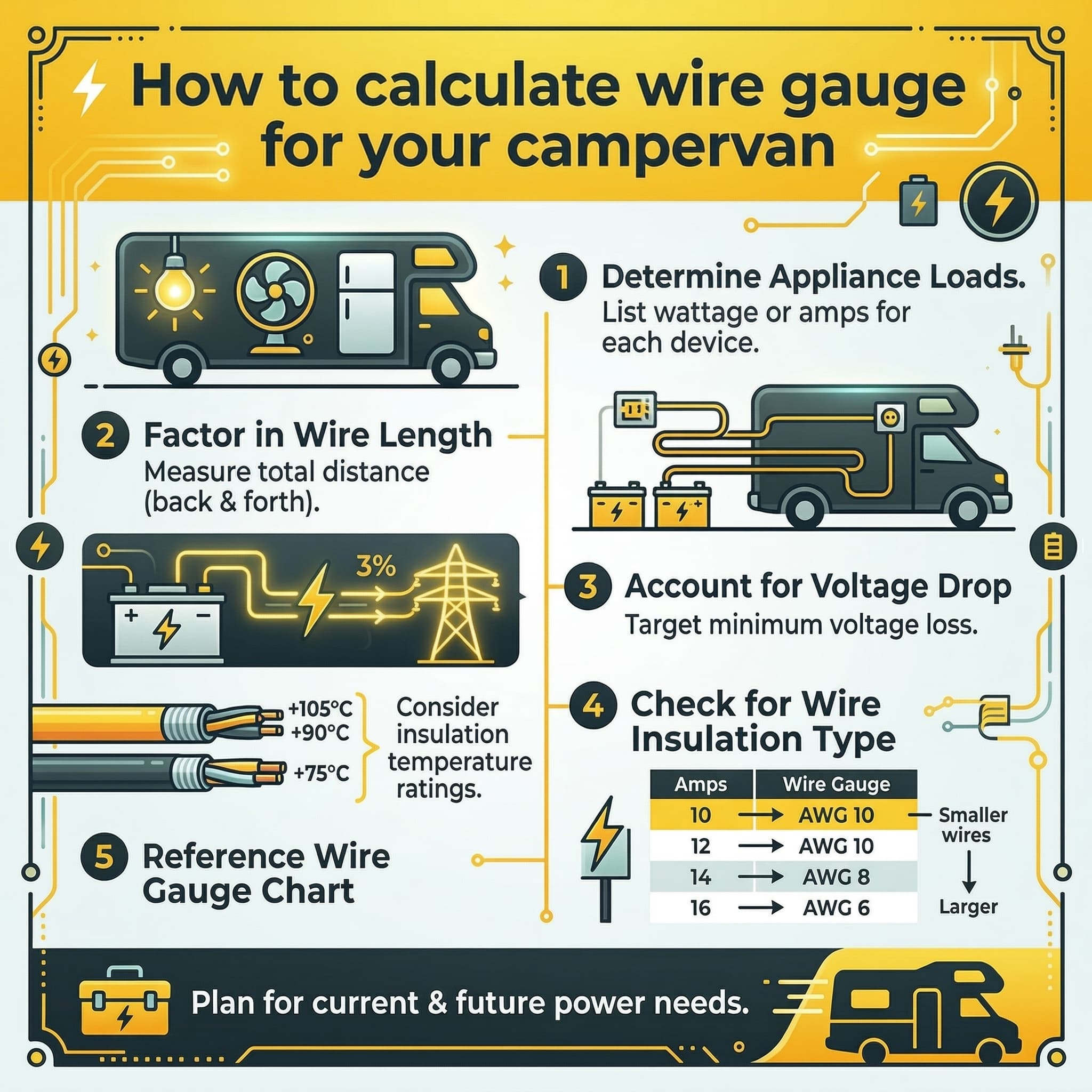
Use this professional reference table to select the correct gauge (mm²) for your cables. For 12V in a van, the maximum tolerated voltage drop is 3%. Always use multi-stranded flexible automotive wire.
| Current (A) | Round trip < 2m | Round trip 4m | Round trip 6m |
|---|---|---|---|
| 5A (LEDs, USB) | 1.5 mm² | 2.5 mm² | 4 mm² |
| 10A (Fridge, Pump) | 2.5 mm² | 4 mm² | 6 mm² |
| 20A (Heater) | 4 mm² | 10 mm² | 10 mm² |
| 50A (DC/DC Booster) | 10 mm² | 16 mm² | 25 mm² |
| 100A (Inverter) | 25 mm² | 35 mm² | 50 mm² |
Fuse Sizing
The fuse protects the wire, not the appliance. Always place it as close to the power source as possible (battery or busbar).
- Wire 1.5 mm² → Max fuse 10A
- Wire 2.5 mm² → Max fuse 20A
- Wire 4 mm² → Max fuse 30A
- Wire 6 mm² → Max fuse 40A
- Wire 10 mm² → Max fuse 60A
SCHÉMA ÉLECTRIQUE
PANNEAUX SOLAIRES
0W
RÉGULATEUR MPPT
BATTERIE AUXILIAIRE
0 Ah
Lithium LiFePO4
FUSIBLE
FUSIBLE
BOÎTE À FUSIBLES 12V
Pompe, Leds, Frigo...
CONVERTISSEUR 220V
NON REQUI
PRO GEARPage 4
SHOPPING LIST
Where to find this equipment? Here is the community-approved selection.
12V 6-way Fuse Box
Mandatory protection
Digital Multimeter
Test your connections
Heavy Duty Crimping Tool
For perfect lugs
Heat Shrink Tubing
Insulation and safety
GENERATED BY VANPOWERCALC.COM
Lighting is one of the easiest circuits in a van build, but I still see people messing it up with oversized wire, no fuse, or LEDs wired in series that fail cascade-style. A typical van lighting circuit draws under 3A total — six LED puck lights at 3W each is only 18W, or 1.5A at 12V. You can run the whole circuit on 0.75mm² wire with a 5A fuse and call it done. The trick is in the layout and dimming, not the electrical complexity.
LED puck lights draw 1-3W each, so even 10 of them only add up to 10-30W (0.8-2.5A at 12V). LED strip lights vary more: 4-14W per meter depending on density and brightness. A 3-meter strip of warm white 60 LED/m pulls about 15W total, or 1.25A. Wire sizing for these loads is minimal — 0.75mm² handles up to 6A in short runs under 3 meters, and 1.5mm² covers up to 10A or longer runs. Use the formula: Section (mm²) = (2 x Length x Current) / (57 x max_voltage_drop). For a 4-meter run at 2A with 3% acceptable drop, that's (2 x 4 x 2) / (57 x 0.36) = 0.78mm², so 1.0mm² wire is perfect.
Expert tip
Run a dedicated "night mode" circuit with just 2-3 red or amber LEDs on a separate switch. Red light doesn't kill your night vision — perfect for midnight bathroom trips without waking up completely. I wired mine with 0.5W red LEDs drawing barely 0.15A total.
Example calculation for your setup
Results based on a typical use case
| Appliance | Power | Usage/day | Wh/day |
|---|---|---|---|
| Compression fridge | 45W | 24h | 1080 |
| LED lighting | 20W | 4h | 80 |
| Water pump | 30W | 0.5h | 15 |
| Phone charging | 15W | 2h | 30 |
| Daily consumption | 1205 Wh | ||
Daily consumption
1205 Wh
4.2A average hours
recommended section
1.5 mm²
For a 3m cable at 12V with this current, use
Adjust these values with the calculator below
About this tool
I've wired lighting in all three of my vans, and my biggest lesson was this: plan your switch and dimmer locations before you run a single wire. Nothing worse than having perfect lights but the switch in an awkward spot.
For layout, I split my van into zones: cab overhead, main living area, kitchen area, and bed area. Each zone gets its own switch or dimmer. This way I can have reading light in bed without lighting up the whole van. All zones share a common positive bus from one fused circuit — I run a 1.5mm² main line from the fuse box, then branch off with 0.75mm² to each zone.
Wiring topology matters. Always wire puck lights in parallel, never in series. In series, if one light fails, they all go dark — and the voltage divides between them so they'll be dim anyway. In parallel, each light gets full 12V, and if one fails, the rest stay on. For LED strips, they're already wired in parallel internally, so you just connect power to the strip ends.
Dimmers are where things get interesting. PWM dimmers work great with 12V LEDs — they rapidly switch the power on/off to reduce perceived brightness. Get a proper 12V PWM dimmer rated for LED loads, not an old resistive dimmer meant for halogen. I like the ones with a rotary knob and push on/off. You can find them for $8-15 and they install inline on the positive wire.
Fuse sizing: total up your maximum lighting load and pick a fuse about 50% above that. My whole van lighting draws a maximum of 2.5A, so I use a 5A fuse. Don't go crazy with a 15A fuse on a lighting circuit — the whole point is to protect the 0.75mm² wire, which can handle about 6A max before it starts getting warm.
One more thing — color temperature. Go warm white (2700-3000K) for living spaces. Cool white looks like a hospital. I learned this the hard way in my first van with 6000K strips. Swapped them out within a week.

Frequently asked questions
What wire size do I need for van LED lights?▼
For most van lighting circuits, 0.75mm² works for short runs under 3 meters at under 3A. For longer runs or if you're daisy-chaining multiple lights, bump up to 1.0mm² or 1.5mm². Use the formula: mm² = (2 x length in meters x amps) / (57 x acceptable voltage drop). Keep voltage drop under 3% — that's 0.36V on a 12V system.
Should I wire LED puck lights in series or parallel?▼
Always parallel. In parallel, each light gets the full 12V and operates independently — if one fails, the rest stay lit. In series, voltage divides between lights (so they'd be dim) and one failure kills the entire string. There's no advantage to series wiring for 12V LED pucks.
How many LED lights can I run on one circuit?▼
With a 5A fuse and 1.0mm² wire, you could theoretically run 20 puck lights at 3W each (60W total, 5A). Realistically, 8-12 lights per circuit is plenty for a van. I run all my lighting — about 10 lights plus a short LED strip — on a single 5A fused circuit drawing under 3A.
Do I need a special dimmer for 12V LED lights?▼
Yes — use a 12V PWM dimmer specifically designed for LED loads. Don't use a resistive dimmer or a 120V/240V household dimmer. A good 12V PWM dimmer costs $8-15, installs inline on the positive wire, and gives smooth dimming without the flickering you get from cheap options. Look for one rated for at least double your total lighting wattage.
How much power do van LED lights actually use per day?▼
Very little. Six 3W puck lights running 5 hours = 90Wh or about 7.5Ah at 12V. Add a 2-meter LED strip at 10W for 4 hours = 40Wh or 3.3Ah. Total: around 10-11Ah per day. That's under 6% of a 200Ah LiFePO4 battery. Lighting is one of the cheapest loads in any van build.
Advertising
Independent and free thanks to your clicks
Links marked with * are affiliate links. If a purchase is made through them, I receive a commission at no extra cost to you. The editorial selection and product evaluation are not influenced by commission rates. Your click helps fund this free tool.
Recommended gear
$41Amazon
12V Fuse Box
Protects each circuit independently, easy installation.“One fuse per circuit is the golden rule. This box keeps your install clean and every line independently protected.”View on Amazon* →$25Amazon
Electrical Crimping Tool
Reliable crimp connections on 0.5mm²–16mm² cables, no soldering.“Forget soldering in a van — crimping is more reliable and vibration-proof. This one covers all the gauges you'll need.”View on Amazon* →$6Amazon
Heat Shrink Tubing Kit
Insulate and protect electrical connections.“Small purchase, big impact. Every connection must be insulated and protected, especially in a van that vibrates constantly.”View on Amazon* →$107Amazon
Digital Multimeter
Measures voltage, current, resistance — essential for 12V wiring.“First tool to buy before you even start your install. You'll pull it out 100 times to check voltages and connections.”View on Amazon* →