Loading...
Fact-checked on Apr 21, 2026
VANPOWERCALC.COMYOUR ENERGY PROFILE
YOUR ENERGY PROFILE.
This document contains the sizing of your future electrical installation, calculated based on your appliances.
Minimum Daily Consumption
0 WH / DAY
Inventory:
SYSTEM SIZINGPage 2
Battery
To guarantee 0WH without damaging your bank (80% max discharge):
0 AH
LiFePO4 12V
Solar
Minimum power required to recharge your consumption:
0 W
via MPPT
220V AC
Maximum power (with 25% safety margin).
0 W
No Need
Safety & CablingPage 3
12V Cable Sizing Guide
Use this professional reference table to select the correct gauge (mm²) for your cables. For 12V in a van, the maximum tolerated voltage drop is 3%. Always use multi-stranded flexible automotive wire.
| Current (A) | Round trip < 2m | Round trip 4m | Round trip 6m |
|---|---|---|---|
| 5A (LEDs, USB) | 1.5 mm² | 2.5 mm² | 4 mm² |
| 10A (Fridge, Pump) | 2.5 mm² | 4 mm² | 6 mm² |
| 20A (Heater) | 4 mm² | 10 mm² | 10 mm² |
| 50A (DC/DC Booster) | 10 mm² | 16 mm² | 25 mm² |
| 100A (Inverter) | 25 mm² | 35 mm² | 50 mm² |
Fuse Sizing
The fuse protects the wire, not the appliance. Always place it as close to the power source as possible (battery or busbar).
- Wire 1.5 mm² → Max fuse 10A
- Wire 2.5 mm² → Max fuse 20A
- Wire 4 mm² → Max fuse 30A
- Wire 6 mm² → Max fuse 40A
- Wire 10 mm² → Max fuse 60A
SCHÉMA ÉLECTRIQUE
PANNEAUX SOLAIRES
0W
RÉGULATEUR MPPT
BATTERIE AUXILIAIRE
0 Ah
Lithium LiFePO4
FUSIBLE
FUSIBLE
BOÎTE À FUSIBLES 12V
Pompe, Leds, Frigo...
CONVERTISSEUR 220V
NON REQUI
PRO GEARPage 4
SHOPPING LIST
Where to find this equipment? Here is the community-approved selection.
12V 6-way Fuse Box
Mandatory protection
Digital Multimeter
Test your connections
Heavy Duty Crimping Tool
For perfect lugs
Heat Shrink Tubing
Insulation and safety
GENERATED BY VANPOWERCALC.COM
Your MPPT says "full" but your batteries are nowhere near charged — this almost always comes down to a voltage mismatch. If your controller is set to an AGM charging profile but you're running LiFePO4 cells, it cuts off at 14.4V instead of 14.6V. That missing 0.2V means your pack never reaches true full charge, and the SOC display on your shunt drifts further from reality over time. I've seen rigs stuck at 70-75% for weeks before the owner figured it out.
The battery type setting on your MPPT is the first thing to check — LiFePO4 needs 14.6V absorption voltage, not the 14.4V used for AGM. Next, inspect your voltage sense wires: if the MPPT reads voltage at its own terminals instead of at the battery, any resistance in the cabling makes the controller think the battery voltage is higher than it actually is. A faulty temperature sensor can also trick the MPPT into reducing charge voltage — disconnect it temporarily and see if charging resumes. Finally, your SOC display might just be wrong: shunt-based monitors need periodic full-charge synchronization to stay accurate.
Expert tip
Disable float charging entirely on LiFePO4. Set float to 13.2V or just turn it off. Floating a lithium bank at 13.6V keeps cells at high SOC permanently, which slightly accelerates calendar aging. Let the MPPT stop when absorption is done — the BMS handles the rest.
Example calculation for your setup
Results based on a typical use case
| Appliance | Power | Usage/day | Wh/day |
|---|---|---|---|
| Compression fridge | 45W | 24h | 1080 |
| LED lighting | 20W | 4h | 80 |
| Water pump | 30W | 0.5h | 15 |
| Phone charging | 15W | 2h | 30 |
| Daily consumption | 1205 Wh | ||
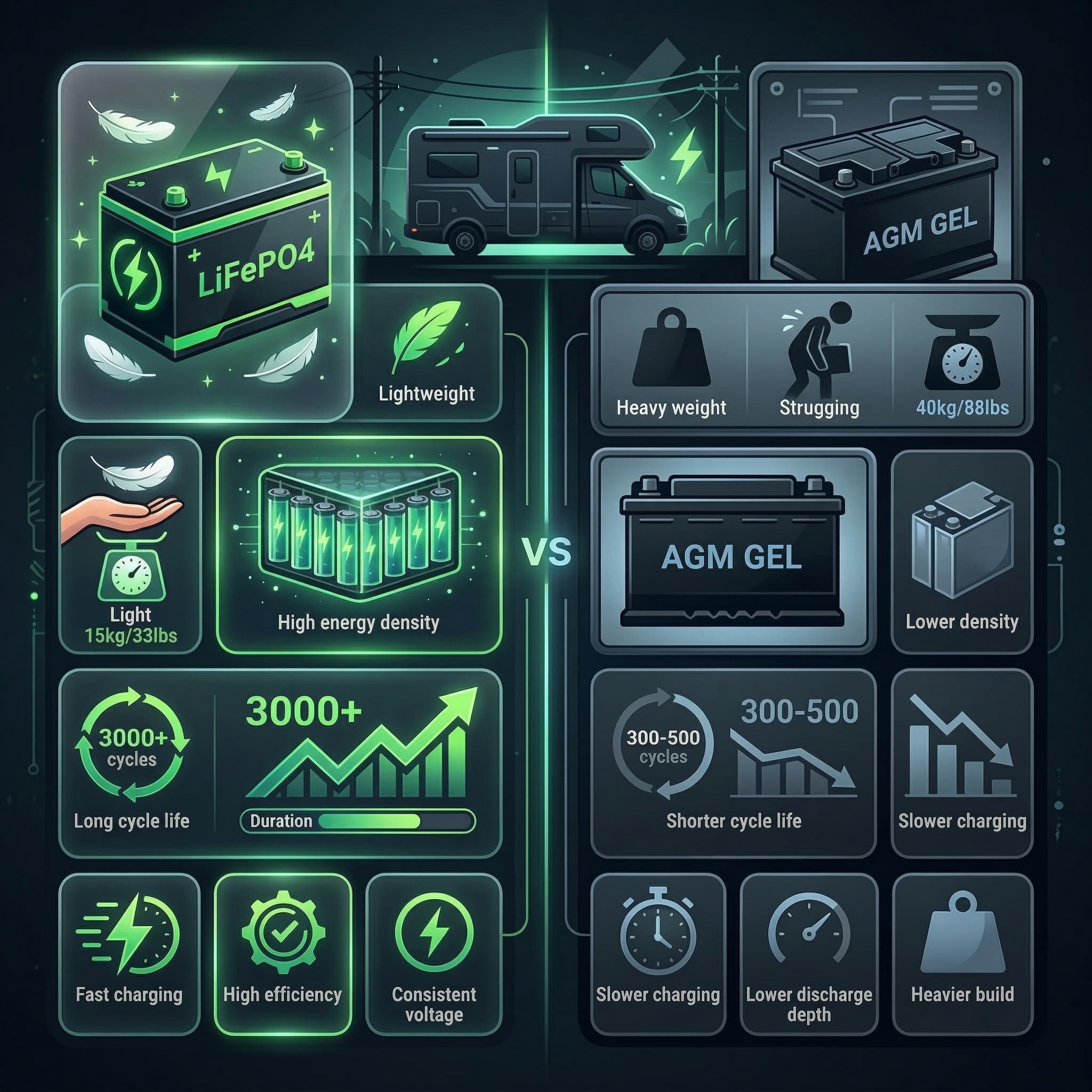
Recommended LiFePO4 battery
151 Ah
(80% depth of discharge)
Recommended AGM battery
241 Ah
(50% depth of discharge)
Adjust these values with the calculator below
About this tool
I ran into this exact problem on my second van build. Brand new 200Ah LiFePO4 bank, Victron 100/30 MPPT, 400W of panels — and VictronConnect kept telling me the battery was full by 10am. Meanwhile, my fridge was shutting down by midnight. Took me two days to realize I'd left the battery profile on "gel" from testing.
Here's the systematic diagnosis I use now:
Measure actual battery voltage with a multimeter at the battery terminals, not through the MPPT display. If you read 13.2V and the controller says 14.4V, you have a wiring resistance problem.
Verify the charge profile. For LiFePO4: absorption at 14.6V, float at 13.6V (or disable float entirely). For AGM: absorption at 14.4V, float at 13.6V.
Check if the MPPT is actually outputting current. An MPPT showing 0A but claiming the battery is full means it genuinely thinks charging is done. If your multimeter shows 13.0V at the battery — that's your smoking gun.
Temperature sensor test. Disconnect your external temp sensor. If the MPPT immediately starts pushing more current, the sensor is either faulty or placed somewhere that reads too hot.
Reset your SOC monitor. Fully charge the battery to a verified 14.6V, let it rest, then manually sync your shunt to 100%.
One edge case that got me: if you have two MPPT controllers on the same bank, one can see the other's charging voltage and assume the battery is full. Solution: set slightly different absorption voltages (14.6V and 14.5V) so they don't confuse each other.

Frequently asked questions
Why does my MPPT show 100% but the battery voltage is only 13.2V?▼
The MPPT's SOC percentage is often just a voltage-based estimate, not a true coulomb count. If your charge profile is set wrong (AGM instead of LiFePO4), the controller hits its lower cutoff voltage, assumes that's 100%, and stops. Measure with a multimeter — 13.2V on a LiFePO4 means roughly 70-80% SOC, not full.
Can corroded battery connections cause the MPPT to show a false full reading?▼
Absolutely. Corrosion adds resistance. The MPPT measures voltage at its own output terminals, not at the battery. With a 0.3-0.5V drop across bad connections, the controller sees 14.6V while the battery only receives 14.1V. Clean all terminals with a wire brush, re-torque lugs to spec, and apply dielectric grease.
Should I use the MPPT's SOC reading or my shunt monitor?▼
Always trust a properly calibrated shunt monitor over the MPPT's built-in percentage. The shunt tracks actual current flow — it's a coulomb counter. The MPPT just estimates based on voltage, which is unreliable for LiFePO4 because the voltage curve is nearly flat between 20% and 80% SOC.
My Renogy MPPT shows bulk charging at 0 amps — what's going on?▼
If the MPPT is in bulk mode but outputting 0A, either the panels aren't producing (shade, night, bad MC4 connection) or the controller's internal MOSFET is fried. Check panel open-circuit voltage at the MPPT input terminals. If you see good voltage but 0A output, the controller is likely dead.
How often should I recalibrate my battery SOC monitor?▼
Every 2-3 weeks if you're off-grid, or whenever you get a guaranteed full charge. Bring the battery to 14.6V, let it sit at absorption until tail current drops below 1-2A, then sync your monitor to 100%. Without this reset, SOC drift of 5-15% is normal over a month of partial cycling.
Advertising
Independent and free thanks to your clicks
Links marked with * are affiliate links. If a purchase is made through them, I receive a commission at no extra cost to you. The editorial selection and product evaluation are not influenced by commission rates. Your click helps fund this free tool.
Recommended gear
$107Amazon
Digital Multimeter
Measures voltage, current, resistance — essential for 12V wiring.“First tool to buy before you even start your install. You'll pull it out 100 times to check voltages and connections.”View on Amazon* →Check price
ECO-WORTHY 200W 12V/24V Solar Kit + 20A Bluetooth MPPTLeo's Pick
Complete 200W solar kit with Bluetooth-monitored MPPT controller. 12V/24V compatible, 20A charge controller with smartphone app. Ideal for vans, RVs, off-grid setups. Single-product solution covering both solar panel and charge controller.“The kit I recommend to every beginner. Plug it in, it works, and the included MPPT controller makes a real difference.”View on Amazon* →Check price
LiTime 12V 100Ah Bluetooth LiFePO4 (Group 31)Leo's Pick
LiFePO4 12V 100Ah Group 31, Bluetooth monitoring, 100A BMS, low-temp cutoff protection. Up to 15000 deep cycles at 60% DoD. Marine, RV, off-grid use. 222 Amazon reviews. LiTime is a leading mainstream LiFePO4 brand on Amazon US.“This is the battery I've been using in my van for 2 years. Reliable, lightweight, and the best value for money out there.”View on Amazon* →