Loading...
Fact-checked on Apr 21, 2026
VANPOWERCALC.COMYOUR ENERGY PROFILE
YOUR ENERGY PROFILE.
This document contains the sizing of your future electrical installation, calculated based on your appliances.
Minimum Daily Consumption
0 WH / DAY
Inventory:
SYSTEM SIZINGPage 2
Battery
To guarantee 0WH without damaging your bank (80% max discharge):
0 AH
LiFePO4 12V
Solar
Minimum power required to recharge your consumption:
0 W
via MPPT
220V AC
Maximum power (with 25% safety margin).
0 W
No Need
Safety & CablingPage 3
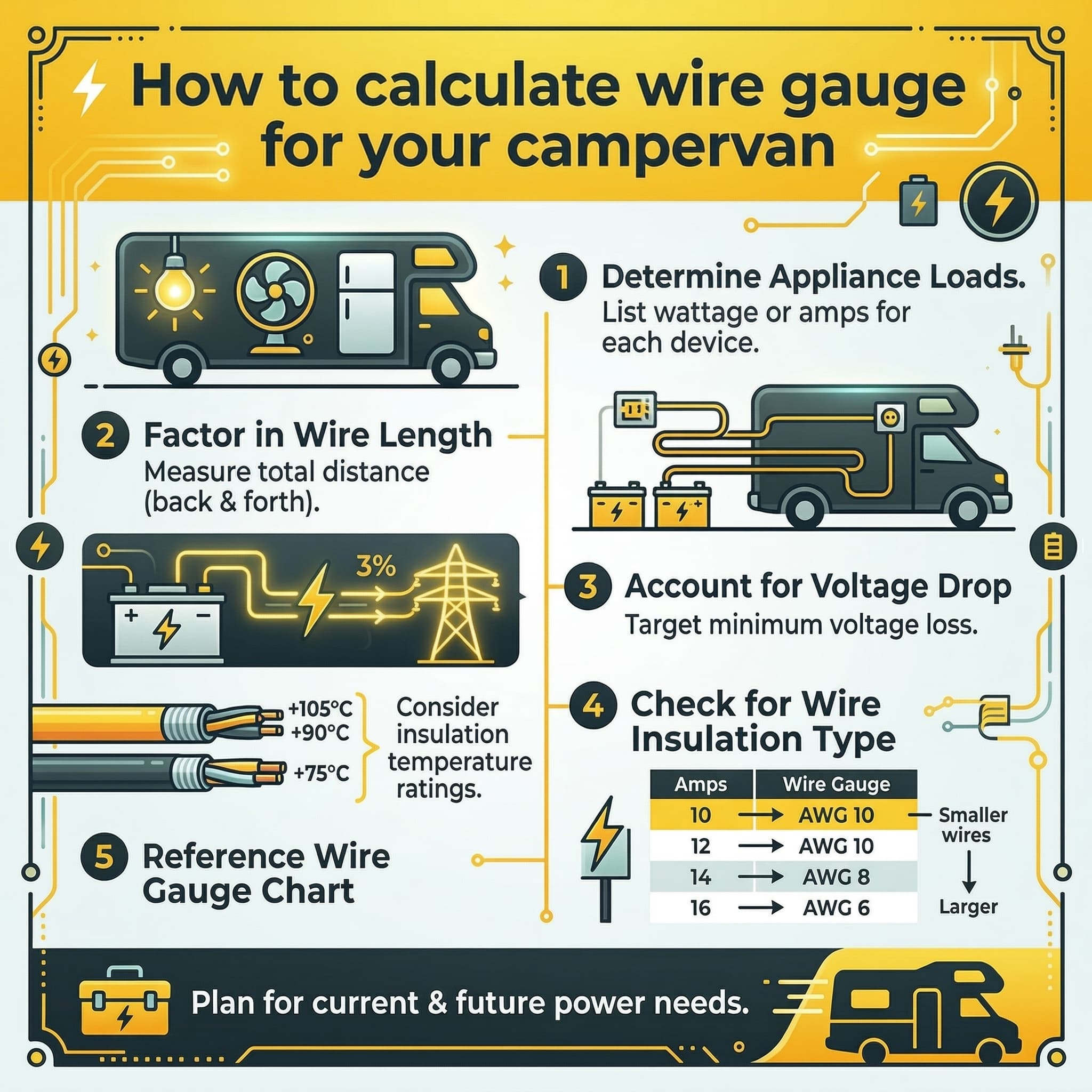
12V Cable Sizing Guide
Use this professional reference table to select the correct gauge (mm²) for your cables. For 12V in a van, the maximum tolerated voltage drop is 3%. Always use multi-stranded flexible automotive wire.
| Current (A) | Round trip < 2m | Round trip 4m | Round trip 6m |
|---|---|---|---|
| 5A (LEDs, USB) | 1.5 mm² | 2.5 mm² | 4 mm² |
| 10A (Fridge, Pump) | 2.5 mm² | 4 mm² | 6 mm² |
| 20A (Heater) | 4 mm² | 10 mm² | 10 mm² |
| 50A (DC/DC Booster) | 10 mm² | 16 mm² | 25 mm² |
| 100A (Inverter) | 25 mm² | 35 mm² | 50 mm² |
Fuse Sizing
The fuse protects the wire, not the appliance. Always place it as close to the power source as possible (battery or busbar).
- Wire 1.5 mm² → Max fuse 10A
- Wire 2.5 mm² → Max fuse 20A
- Wire 4 mm² → Max fuse 30A
- Wire 6 mm² → Max fuse 40A
- Wire 10 mm² → Max fuse 60A
SCHÉMA ÉLECTRIQUE
PANNEAUX SOLAIRES
0W
RÉGULATEUR MPPT
BATTERIE AUXILIAIRE
0 Ah
Lithium LiFePO4
FUSIBLE
FUSIBLE
BOÎTE À FUSIBLES 12V
Pompe, Leds, Frigo...
CONVERTISSEUR 220V
NON REQUI
PRO GEARPage 4
SHOPPING LIST
Where to find this equipment? Here is the community-approved selection.
12V 6-way Fuse Box
Mandatory protection
Digital Multimeter
Test your connections
Heavy Duty Crimping Tool
For perfect lugs
Heat Shrink Tubing
Insulation and safety
GENERATED BY VANPOWERCALC.COM
Running 6,000W of inverter capacity in a tow-behind camper is serious power — we're talking full-size AC, microwave, and maybe even a washer/dryer. At 12V, that'd pull a terrifying 500A+ from the batteries. That's why this build demands 24V minimum, bringing your max draw down to about 260A. The setup I'm breaking down uses two Victron MultiPlus 24/3000/70 inverters with a 50A shore power inlet, and honestly, it's one of the cleanest high-power architectures I've come across for towable campers.
At 24V with 6,000W peak draw, maximum current is ~260A versus 500A+ at 12V for the same power. That drops your main battery cable from an unwieldy 95mm² at 12V down to 50mm² at 24V. Each Victron MultiPlus 24/3000/70 handles 3,000VA continuous with 6,000W surge. Wire them in parallel for 6,000VA at 120V single-phase, or configure split-phase for 120/240V with 3,000VA per leg. The 50A shore power inlet at 120V provides 6,000W of charging capacity — enough to charge and run loads simultaneously. Battery bank: minimum 24V 400Ah (9.6kWh) using 8x 12V 100Ah LiFePO4 in a 4S2P configuration.
Expert tip
Set the Victron MultiPlus "PowerAssist" feature — it supplements shore power with battery power during peak loads. On a 30A campsite pedestal, you can still run 5,000W+ total because the inverters pull the extra watts from the batteries. No more tripping campground breakers.
Example calculation for your setup
Results based on a typical use case
| Appliance | Power | Usage/day | Wh/day |
|---|---|---|---|
| Compression fridge | 45W | 24h | 1080 |
| LED lighting | 20W | 4h | 80 |
| Water pump | 30W | 0.5h | 15 |
| Phone charging | 15W | 2h | 30 |
| Daily consumption | 1205 Wh | ||
Recommended inverter
No 220V appliances — no inverter needed
Adjust these values with the calculator below
About this tool
I helped a buddy wire up a 30-foot tow-behind last year with this exact architecture, and the decision to go 24V instead of 12V saved us probably $800 in copper alone. Let me walk through the key decisions.
Parallel vs split-phase is the first fork in the road. In North America, if you want to run a 240V appliance (like certain dryers or water heaters), you need split-phase — each inverter produces one 120V leg, 180 degrees apart, giving you 240V between the two hot legs. But if all your loads are 120V, parallel mode doubles your capacity to 6,000VA on a single 120V circuit. Most tow-behind campers use parallel mode since RV appliances are all 120V.
The Victron MultiPlus is ideal here because it has a built-in transfer switch and charger. When you plug into the 50A shore power pedestal, it automatically switches from inverting to pass-through and starts charging the batteries at up to 70A per unit (140A total at 24V). That's over 3,300W of charging power, which can refill a 400Ah bank from 20% to full in about 6-7 hours.
Cable sizing is where 24V really shines. The run from battery bank to inverters needs to handle 260A worst case. At 24V with a 1-meter cable run and 1% voltage drop target: mm² = (2 x 1 x 260) / (57 x 0.24) = 38mm². So 50mm² cable gives you comfortable margin. At 12V, same calculation gives you 76mm² — you'd need 95mm² cable, which costs roughly double and is nearly impossible to bend in tight spaces.
The 50A inlet needs proper wiring too. A 50A RV plug (NEMA 14-50) actually carries two 50A hot legs at 120V each in a split-phase setup. If you're running parallel single-phase, you'll wire both hot legs together through a proper junction, or better yet, use a 30A inlet (TT-30) if you don't need the full 50A shore capacity.
Battery fusing: each inverter gets its own fused disconnect. At 130A max per unit, use a 150A or 175A Class T fuse on each. The main battery bank should have a 300A or 400A master fuse. Don't skip the fusing — at 260A, an unfused short circuit will melt copper and start fires in seconds.

Frequently asked questions
Why 24V instead of 12V for a dual inverter setup?▼
At 6,000W total power, a 12V system would pull over 500A — requiring 95mm² cables, massive fuses, and bus bars rated for industrial current. At 24V, the same 6,000W only pulls ~260A. That cuts cable costs nearly in half, allows smaller fuses, and makes the whole system physically manageable. For anything over 3,000W, 24V is the minimum. Over 6,000W, I'd look at 48V.
Should I wire the dual inverters in parallel or split-phase?▼
If all your loads are 120V (which covers 99% of RV appliances), go parallel — you get 6,000VA on a single 120V output. Only go split-phase if you specifically need 240V for something like a hardwired water heater or clothes dryer. Split-phase gives you 3,000VA per leg, and you need to balance loads between legs or you waste capacity.
How big should the battery bank be for dual 3000W inverters?▼
Minimum 24V 400Ah (9.6kWh) for daily use with solar recharging. That's 8x 12V 100Ah LiFePO4 batteries — four in series for 24V, two strings in parallel for 400Ah. If you're running the AC unit (1,500W) plus other loads frequently, 600Ah (14.4kWh) gives better autonomy. With 400Ah, running both inverters at full power drains the bank in about 1.5 hours.
What fuse size do I need between batteries and inverters?▼
Each Victron MultiPlus 24/3000 can pull up to 130A at 24V. Use a 150A or 175A Class T fuse on each inverter's DC input. Then put a 300-400A main fuse at the battery bank's positive terminal as a master disconnect. Class T fuses are mandatory for inverter circuits because they can interrupt DC fault currents of 20,000A+.
Can I charge the batteries while running the inverters on shore power?▼
Yes — that's the whole point of the Victron MultiPlus design. When shore power is connected, it passes AC through to your loads and simultaneously charges the batteries at up to 70A per unit (140A combined at 24V). If your loads exceed the shore power capacity, the PowerAssist feature kicks in and supplements from the batteries automatically.
Advertising
Independent and free thanks to your clicks
Links marked with * are affiliate links. If a purchase is made through them, I receive a commission at no extra cost to you. The editorial selection and product evaluation are not influenced by commission rates. Your click helps fund this free tool.
Recommended gear
$176Amazon
Pure Sine Wave Inverter 1000W
Pure sine wave, sensitive devices compatible, 12V→110V/230V.“If you need to run a microwave or coffee machine, this is the one. Pure sine wave = zero risk for your gear.”View on Amazon* →Check price
LiTime 12V 100Ah Bluetooth LiFePO4 (Group 31)Leo's Pick
LiFePO4 12V 100Ah Group 31, Bluetooth monitoring, 100A BMS, low-temp cutoff protection. Up to 15000 deep cycles at 60% DoD. Marine, RV, off-grid use. 222 Amazon reviews. LiTime is a leading mainstream LiFePO4 brand on Amazon US.“This is the battery I've been using in my van for 2 years. Reliable, lightweight, and the best value for money out there.”View on Amazon* →$41Amazon
12V Fuse Box
Protects each circuit independently, easy installation.“One fuse per circuit is the golden rule. This box keeps your install clean and every line independently protected.”View on Amazon* →$25Amazon
Electrical Crimping Tool
Reliable crimp connections on 0.5mm²–16mm² cables, no soldering.“Forget soldering in a van — crimping is more reliable and vibration-proof. This one covers all the gauges you'll need.”View on Amazon* →