Loading...
Fact-checked on Apr 21, 2026
VANPOWERCALC.COMYOUR ENERGY PROFILE
YOUR ENERGY PROFILE.
This document contains the sizing of your future electrical installation, calculated based on your appliances.
Minimum Daily Consumption
0 WH / DAY
Inventory:
SYSTEM SIZINGPage 2
Battery
To guarantee 0WH without damaging your bank (80% max discharge):
0 AH
LiFePO4 12V
Solar
Minimum power required to recharge your consumption:
0 W
via MPPT
220V AC
Maximum power (with 25% safety margin).
0 W
No Need
Safety & CablingPage 3
12V Cable Sizing Guide
Use this professional reference table to select the correct gauge (mm²) for your cables. For 12V in a van, the maximum tolerated voltage drop is 3%. Always use multi-stranded flexible automotive wire.
| Current (A) | Round trip < 2m | Round trip 4m | Round trip 6m |
|---|---|---|---|
| 5A (LEDs, USB) | 1.5 mm² | 2.5 mm² | 4 mm² |
| 10A (Fridge, Pump) | 2.5 mm² | 4 mm² | 6 mm² |
| 20A (Heater) | 4 mm² | 10 mm² | 10 mm² |
| 50A (DC/DC Booster) | 10 mm² | 16 mm² | 25 mm² |
| 100A (Inverter) | 25 mm² | 35 mm² | 50 mm² |
Fuse Sizing
The fuse protects the wire, not the appliance. Always place it as close to the power source as possible (battery or busbar).
- Wire 1.5 mm² → Max fuse 10A
- Wire 2.5 mm² → Max fuse 20A
- Wire 4 mm² → Max fuse 30A
- Wire 6 mm² → Max fuse 40A
- Wire 10 mm² → Max fuse 60A
SCHÉMA ÉLECTRIQUE
PANNEAUX SOLAIRES
0W
RÉGULATEUR MPPT
BATTERIE AUXILIAIRE
0 Ah
Lithium LiFePO4
FUSIBLE
FUSIBLE
BOÎTE À FUSIBLES 12V
Pompe, Leds, Frigo...
CONVERTISSEUR 220V
NON REQUI
PRO GEARPage 4
SHOPPING LIST
Where to find this equipment? Here is the community-approved selection.
12V 6-way Fuse Box
Mandatory protection
Digital Multimeter
Test your connections
Heavy Duty Crimping Tool
For perfect lugs
Heat Shrink Tubing
Insulation and safety
GENERATED BY VANPOWERCALC.COM
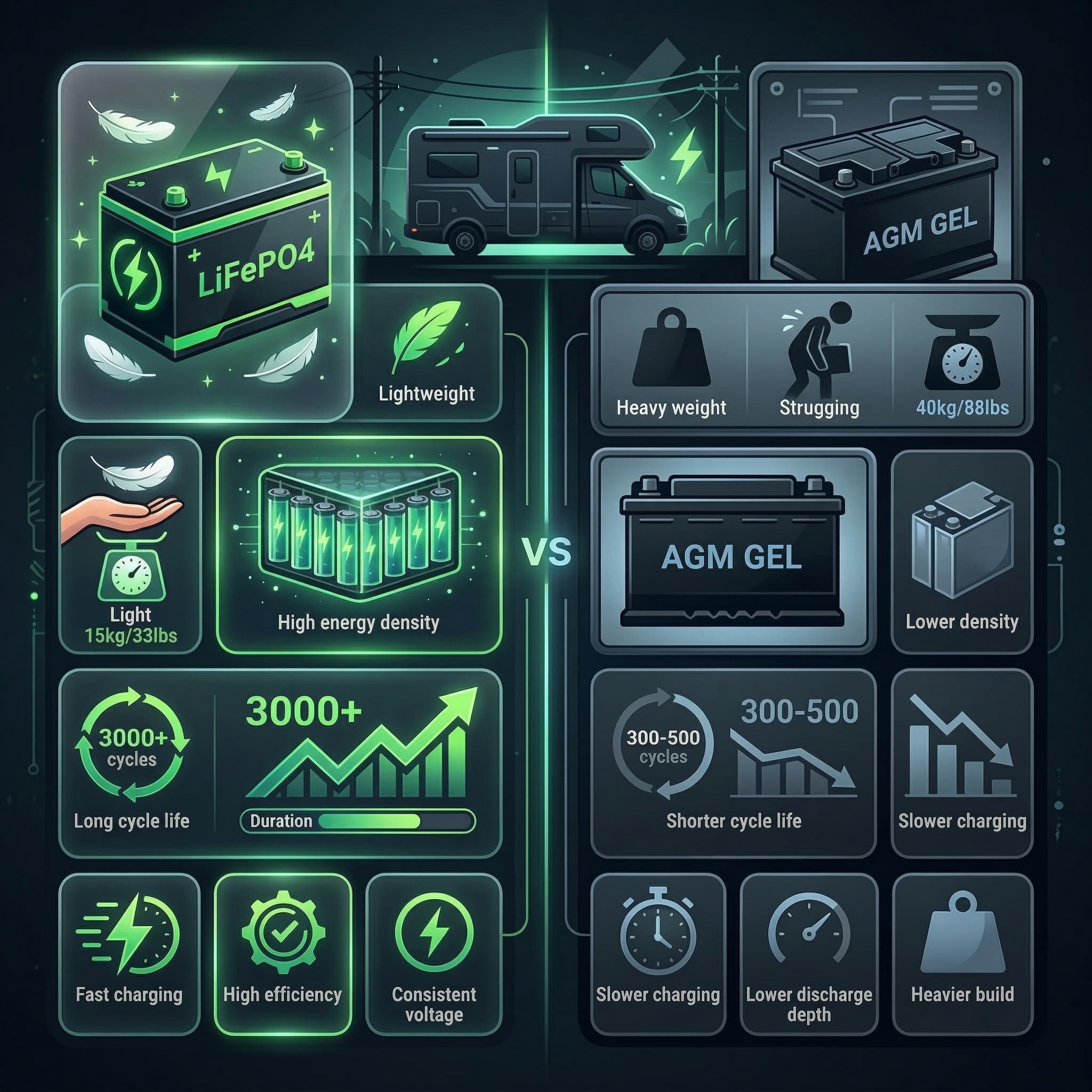
I'll cut to it: if you're building a van for more than occasional weekend trips, LiFePO4 is the only battery that makes financial sense long-term. A 200Ah LiFePO4 costs around $800-1,000 but delivers 3,000-5,000 cycles at 80-90% depth of discharge. A 200Ah AGM costs $250-350 but only survives 400-600 cycles at 50% DoD. Do the cost-per-usable-kWh math and LiFePO4 is 3-4x cheaper over its lifetime.
Here are the specs that matter. LiFePO4: 12.8V nominal, charge at 14.6V (never 14.2 or 14.4 — that's for other lithium chemistries), 80-95% usable capacity, 3,000-5,000 cycles, weighs about 25kg for 200Ah. AGM: 12.6V nominal, charge at 14.4V, only 50% usable capacity (discharge below that and you kill it fast), 400-600 cycles, weighs 55-60kg for 200Ah. So a "200Ah" AGM really gives you 100Ah usable, while a 200Ah LiFePO4 gives you 160-190Ah usable. You need two AGMs to match one LiFePO4 in real capacity — and they'll weigh 120kg versus 25kg. For lead-acid (flooded), the numbers are even worse: 50% DoD, 200-300 cycles, and they off-gas hydrogen so you need ventilation.
Expert tip
When buying LiFePO4, check the BMS specs, not just capacity. A battery with a 100A continuous BMS discharge rating can't run a 2000W inverter (that's 156A at 12.8V). You'll hit BMS cutoff under load. Look for 150A+ BMS for any setup with an inverter over 1500W.
Example calculation for your setup
Results based on a typical use case
| Appliance | Power | Usage/day | Wh/day |
|---|---|---|---|
| Compression fridge | 45W | 24h | 1080 |
| LED lighting | 20W | 4h | 80 |
| Water pump | 30W | 0.5h | 15 |
| Phone charging | 15W | 2h | 30 |
| Daily consumption | 1205 Wh | ||
Recommended LiFePO4 battery
151 Ah
(80% depth of discharge)
Recommended AGM battery
241 Ah
(50% depth of discharge)
Adjust these values with the calculator below
About this tool
I started my first van build in 2019 with two 120Ah AGM batteries because LiFePO4 seemed too expensive. Within 18 months, one AGM was toast — I'd accidentally drained it below 50% a handful of times during a winter stretch in the Alps. That's $300 gone plus the hassle of swapping a 60kg battery in a van. I switched to a single 200Ah LiFePO4 and haven't looked back.
Here's how to actually size your battery. Step 1: audit your daily consumption. List every device, its draw in watts, and hours of use. My typical day: fridge 45W x 12h = 540Wh, lights 15W x 5h = 75Wh, laptop 60W x 3h = 180Wh, phone charging 15W x 2h = 30Wh, diesel heater 10W x 8h = 80Wh. Total: roughly 900Wh/day.
Step 2: convert to Ah. 900Wh / 12.8V = 70Ah per day from a LiFePO4 bank. With AGM, same consumption but divide by 12.6V and then double it (because you can only use 50%): you'd need 143Ah of rated capacity per day.
Step 3: add a buffer. I recommend 1.5-2 days of autonomy for off-grid camping. So 70Ah x 2 days = 140Ah minimum LiFePO4, or 143Ah x 2 = 286Ah minimum AGM.
Step 4: factor in recharge. With solar (accounting for ~15% real-world losses), 400W of panels in summer gives you roughly 1,400-1,700Wh on a good day. That covers my 900Wh consumption with margin. In winter, I'd get maybe 500-800Wh — not enough, so I supplement with alternator charging via a DC-DC charger.
The cost-per-cycle math kills the AGM argument. A $900 LiFePO4 at 200Ah, 85% DoD, 4,000 cycles = $0.0013 per usable Ah-cycle. A $300 AGM at 200Ah, 50% DoD, 500 cycles = $0.006 per usable Ah-cycle. LiFePO4 is 4.6x cheaper per unit of energy delivered over its lifetime. The only scenario where AGM wins is if you're building a weekend camper you'll use 30 times and then sell.

Frequently asked questions
Is LiFePO4 worth the extra cost for a van battery?▼
Yes, unless you're building a weekend-only camper. The upfront cost is 3-4x higher, but you get 8x more charge cycles, nearly double the usable capacity per Ah rating, and a third of the weight. Over a 3+ year van life span, LiFePO4 costs about 4.6x less per unit of energy delivered than AGM.
How do I calculate what battery size I need for my van?▼
Audit daily consumption (watts x hours for each device), convert to Ah (total Wh / battery voltage), multiply by your desired days of autonomy (1.5-2 days recommended), then account for depth of discharge. For LiFePO4, divide by 0.85. For AGM, divide by 0.5. A typical van setup consuming 900Wh/day needs about 165Ah LiFePO4 or 285Ah AGM for 2-day autonomy.
What voltage should I charge LiFePO4 batteries to?▼
14.6V — always. Not 14.2V, not 14.4V. Those voltages are for other lithium chemistries or older specs. LiFePO4 cells reach full charge at 3.65V per cell x 4 cells = 14.6V. Setting your charger lower means you'll never reach 100% SOC, leaving 5-15% of your capacity unused.
Can I replace AGM with LiFePO4 without changing anything else?▼
Mostly, but check three things. First, your alternator's charging profile — you likely need a DC-DC charger (like a Victron Orion) set to LiFePO4 profile at 14.6V. Direct alternator connection risks overcharging or damaging the alternator. Second, your solar charge controller must support LiFePO4 settings. Third, verify your BMS can handle your maximum discharge current (inverter startup surges can hit 200A+).
How long will a 200Ah LiFePO4 battery last in a van?▼
At typical van consumption of 70Ah per day (fridge, lights, laptop, phones), a 200Ah LiFePO4 at 85% DoD gives you about 2.4 days without any recharging. With 400W of solar in summer, you're essentially indefinite. The battery itself should last 8-12 years at one cycle per day — 3,000-5,000 cycles is the rated lifespan.
Advertising
Independent and free thanks to your clicks
Links marked with * are affiliate links. If a purchase is made through them, I receive a commission at no extra cost to you. The editorial selection and product evaluation are not influenced by commission rates. Your click helps fund this free tool.
Recommended gear
Check price
LiTime 12V 100Ah Bluetooth LiFePO4 (Group 31)Leo's Pick
LiFePO4 12V 100Ah Group 31, Bluetooth monitoring, 100A BMS, low-temp cutoff protection. Up to 15000 deep cycles at 60% DoD. Marine, RV, off-grid use. 222 Amazon reviews. LiTime is a leading mainstream LiFePO4 brand on Amazon US.“This is the battery I've been using in my van for 2 years. Reliable, lightweight, and the best value for money out there.”View on Amazon* →$41Amazon
12V Fuse Box
Protects each circuit independently, easy installation.“One fuse per circuit is the golden rule. This box keeps your install clean and every line independently protected.”View on Amazon* →$107Amazon
Digital Multimeter
Measures voltage, current, resistance — essential for 12V wiring.“First tool to buy before you even start your install. You'll pull it out 100 times to check voltages and connections.”View on Amazon* →$25Amazon
Electrical Crimping Tool
Reliable crimp connections on 0.5mm²–16mm² cables, no soldering.“Forget soldering in a van — crimping is more reliable and vibration-proof. This one covers all the gauges you'll need.”View on Amazon* →