Loading...
Fact-checked on Apr 21, 2026
VANPOWERCALC.COMYOUR ENERGY PROFILE
YOUR ENERGY PROFILE.
This document contains the sizing of your future electrical installation, calculated based on your appliances.
Minimum Daily Consumption
0 WH / DAY
Inventory:
SYSTEM SIZINGPage 2
Battery
To guarantee 0WH without damaging your bank (80% max discharge):
0 AH
LiFePO4 12V
Solar
Minimum power required to recharge your consumption:
0 W
via MPPT
220V AC
Maximum power (with 25% safety margin).
0 W
No Need
Safety & CablingPage 3
12V Cable Sizing Guide
Use this professional reference table to select the correct gauge (mm²) for your cables. For 12V in a van, the maximum tolerated voltage drop is 3%. Always use multi-stranded flexible automotive wire.
| Current (A) | Round trip < 2m | Round trip 4m | Round trip 6m |
|---|---|---|---|
| 5A (LEDs, USB) | 1.5 mm² | 2.5 mm² | 4 mm² |
| 10A (Fridge, Pump) | 2.5 mm² | 4 mm² | 6 mm² |
| 20A (Heater) | 4 mm² | 10 mm² | 10 mm² |
| 50A (DC/DC Booster) | 10 mm² | 16 mm² | 25 mm² |
| 100A (Inverter) | 25 mm² | 35 mm² | 50 mm² |
Fuse Sizing
The fuse protects the wire, not the appliance. Always place it as close to the power source as possible (battery or busbar).
- Wire 1.5 mm² → Max fuse 10A
- Wire 2.5 mm² → Max fuse 20A
- Wire 4 mm² → Max fuse 30A
- Wire 6 mm² → Max fuse 40A
- Wire 10 mm² → Max fuse 60A
SCHÉMA ÉLECTRIQUE
PANNEAUX SOLAIRES
0W
RÉGULATEUR MPPT
BATTERIE AUXILIAIRE
0 Ah
Lithium LiFePO4
FUSIBLE
FUSIBLE
BOÎTE À FUSIBLES 12V
Pompe, Leds, Frigo...
CONVERTISSEUR 220V
NON REQUI
PRO GEARPage 4
SHOPPING LIST
Where to find this equipment? Here is the community-approved selection.
12V 6-way Fuse Box
Mandatory protection
Digital Multimeter
Test your connections
Heavy Duty Crimping Tool
For perfect lugs
Heat Shrink Tubing
Insulation and safety
GENERATED BY VANPOWERCALC.COM
The Victron MultiPlus is the inverter-charger that keeps showing up in serious van builds, and for good reason. I've installed the 12/2000/80 in three builds and the 12/3000/120 in two. Both are solid units, but they serve different use cases and the price gap is significant. The 2000VA (1600W continuous) runs about $900-1,100, while the 3000VA (2400W continuous) jumps to $1,400-1,700. That's a lot of money, so let me help you figure out which one you actually need.
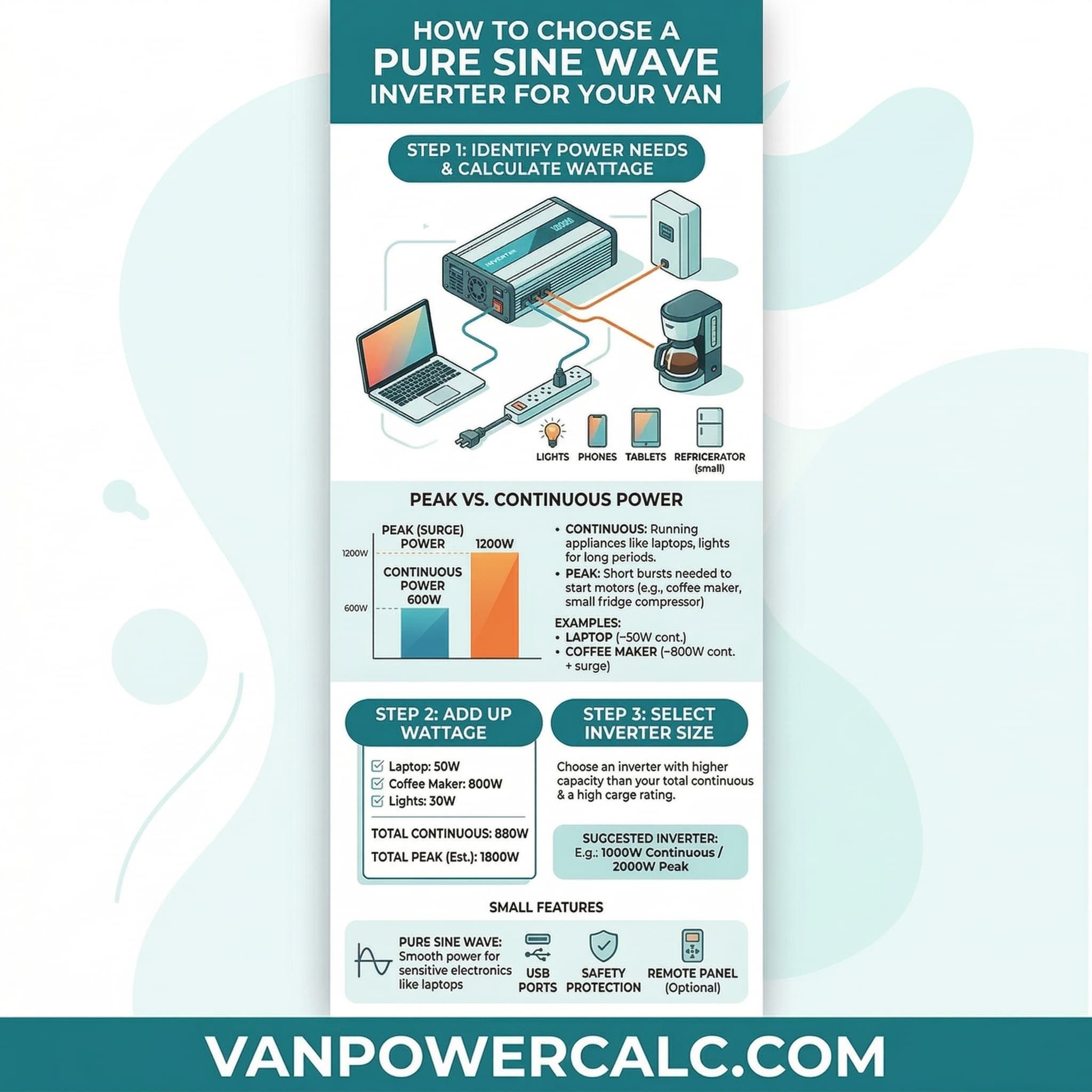
First, the basics. Both are combined inverter-chargers with transfer switch, meaning they handle solar/battery power, shore power charging, and automatic switchover in one box. The 2000VA model outputs 1600W continuous with a 3600W surge rating, draws up to 167A from the battery at full load, and charges at 80A from shore power. The 3000VA outputs 2400W continuous with a 6000W surge rating, draws up to 250A at full load, and charges at 120A from shore. Both produce true sine wave AC output. The key feature that sets the MultiPlus apart from basic inverters is PowerAssist. When you're plugged into a weak shore power source — say a 10A European campsite socket that can only deliver 2,300W — the MultiPlus supplements shore power with battery power. If you're running a 1,500W microwave while already pulling 1,800W from shore, instead of tripping the campsite breaker, the MultiPlus pulls the extra 1,000W from the battery. This is genuinely useful in Europe where campsite power is often limited to 6A or 10A.
Expert tip
Install the MultiPlus with the AC output wired to a proper consumer unit with RCD/GFCI protection. Victron recommends this but doesn't enforce it. Also, update the firmware via VE.Bus before first use — older firmware versions have known bugs with LiFePO4 charge profiles. Set the absorption voltage to 14.6V and float to 13.5V for LiFePO4. Default lead-acid settings will undercharge your lithium bank.
Example calculation for your setup
Results based on a typical use case
| Appliance | Power | Usage/day | Wh/day |
|---|---|---|---|
| Compression fridge | 45W | 24h | 1080 |
| LED lighting | 20W | 4h | 80 |
| Water pump | 30W | 0.5h | 15 |
| Phone charging | 15W | 2h | 30 |
| Daily consumption | 1205 Wh | ||
Recommended inverter
No 220V appliances — no inverter needed
Adjust these values with the calculator below
About this tool
Let me break down the real-world differences that matter for van builds.
Physical size and weight: the 2000VA measures 375 x 214 x 110mm and weighs 12kg. The 3000VA is 362 x 258 x 218mm and weighs 18kg. That extra 6kg and larger footprint matters in a van where every centimeter counts. I've mounted the 2000 under a bench seat with room to spare. The 3000 needs a dedicated electrical cabinet.
Battery cable requirements: this is where it gets real. The 2000VA at full load pulls 167A at 12V — that needs 50mm² (1/0 AWG) cable minimum for runs under 1.5m. The 3000VA at full load pulls 250A, requiring 70mm² (2/0 AWG) cable. Those cables are expensive and stiff. Your battery bank also needs to deliver that current — a single 100Ah LiFePO4 battery typically maxes out at 100-200A continuous discharge. For the 3000VA at full load, you need at least a 200Ah bank, preferably 300Ah.
Charging from shore: the 2000VA charges at 80A, the 3000VA at 120A. With LiFePO4 batteries accepting charge voltage at 14.6V, the 2000 pushes about 1,170W into the battery, the 3000 pushes about 1,750W. For a 200Ah bank, the 2000 charges from 20% to 100% in roughly 2 hours, the 3000 does it in about 1.3 hours. Nice, but rarely the deciding factor.
Cerbo GX integration: both MultiPlus models connect to the Cerbo GX via VE.Bus cable, giving you full monitoring and control through the VRM portal or the Touch 50/70 display. You can set charge parameters, schedule quiet hours (inverter off at night at a campsite), configure PowerAssist limits, and monitor real-time power flow. The integration is the main reason people pay the Victron premium — the ecosystem works together seamlessly.
Which one do I recommend? For 90% of van builds, the 2000VA is the right call. It runs a microwave (800-1000W), a hair dryer on low (1000W), charges laptops and phones, and powers a small AC unit. The 3000VA makes sense only if you need to run high-draw appliances simultaneously — like an induction cooktop (1800W) plus other loads, or a large AC unit. But at that point, question whether you actually need those appliances on battery, because 2400W at 12V is 200A continuous draw. A 200Ah LiFePO4 bank would last one hour at that rate.
Alternatives worth considering: the Victron Phoenix 12/2000 is an inverter-only unit at about $600 if you don't need built-in charging. The Renogy 2000W inverter-charger runs about $450 but lacks PowerAssist and the Victron ecosystem. The Giandel 2000W pure sine inverter is $200 but is inverter-only with no charger, no transfer switch, and no smart integration.

Frequently asked questions
Is the Victron MultiPlus 3000VA worth the extra cost over the 2000VA for a van?▼
For most van builds, no. The 2000VA (1600W continuous) handles microwaves, hair dryers, and charging. The 3000VA only makes sense if you regularly run loads over 1600W simultaneously, like an induction cooktop plus other appliances. The 3000 also needs heavier cables (70mm²) and a larger battery bank.
What battery bank size do I need for the Victron MultiPlus?▼
For the 2000VA at full load (167A draw), a 200Ah LiFePO4 bank is the minimum — it gives about 1 hour at max draw. For the 3000VA (250A draw), you need 300Ah minimum. Most van builds pair the 2000VA with a 200-300Ah bank for 2-4 hours of moderate use.
How do I configure the MultiPlus for LiFePO4 batteries?▼
Set absorption voltage to 14.6V and float to 13.5V via the VE.Configure software or Cerbo GX. The default lead-acid profile (14.4V absorption) will undercharge LiFePO4. Also enable the lithium battery preset if available in your firmware version.
Does the MultiPlus work without a Cerbo GX?▼
Yes, it works standalone with default settings. But without the Cerbo GX, you lose remote monitoring, PowerAssist fine-tuning, charge profile customization, and integration with other Victron components (MPPT, BMV). The Cerbo GX ($250-300) is highly recommended.
Can the MultiPlus charge from both shore power and solar simultaneously?▼
The MultiPlus handles shore power charging. Solar charging runs through a separate MPPT controller directly to the battery. Both can charge simultaneously — the BMS manages total charge current. With the Cerbo GX, you can monitor both sources in real time and the system coordinates automatically via DVCC.
Advertising
Independent and free thanks to your clicks
Links marked with * are affiliate links. If a purchase is made through them, I receive a commission at no extra cost to you. The editorial selection and product evaluation are not influenced by commission rates. Your click helps fund this free tool.
Recommended gear
$104Amazon
Pure Sine Inverter 2000W 12V
Runs induction cooktop, hair dryer, coffee machine.“The 2000W version for those who want to plug in everything: induction plate, hair dryer, pro coffee machine. Make sure your cables are properly sized.”View on Amazon* →$33Amazon
Battery Cable 50mm² Red+Black
50mm² cable for 2000W+ inverter. Red and black, 1m each.“Between battery and inverter, you need heavy-duty cable. 50mm² handles big current draws without overheating.”View on Amazon* →$13Amazon
ANL Fuse 250A + Fuse Holder
Mandatory inverter protection. 250A with integrated fuse holder.“The ANL fuse protects your battery-to-inverter cable. It's a few bucks that can prevent a fire. Non-negotiable.”View on Amazon* →Check price
LiFePO4 200Ah 12V Battery
200Ah true capacity, 200A built-in BMS, 5000+ cycles.“If you work remotely or run a fridge, go straight for 200Ah. You'll never regret having too much capacity.”View on Amazon* →