Loading...
The SOK 12V 206Ah is a solid battery but cell imbalance is its most reported issue. The internal BMS passive balancers only work at 30-60mA -- that's tiny. If one cell drifts 0.1V from the others, it takes hours at full charge voltage to equalize. Most people never hold 14.6V long enough for balancing to complete.
Here's what happens. You charge your SOK to 14.6V with solar. The MPPT hits absorption, holds for maybe 30 minutes, then drops to float at 13.6V. That's not enough time. With a 0.1V imbalance and 40mA balancing current, full equalization takes 4-8 hours at absorption voltage. Your solar controller doesn't hold absorption that long -- it's designed for faster charging, not for cell balancing.
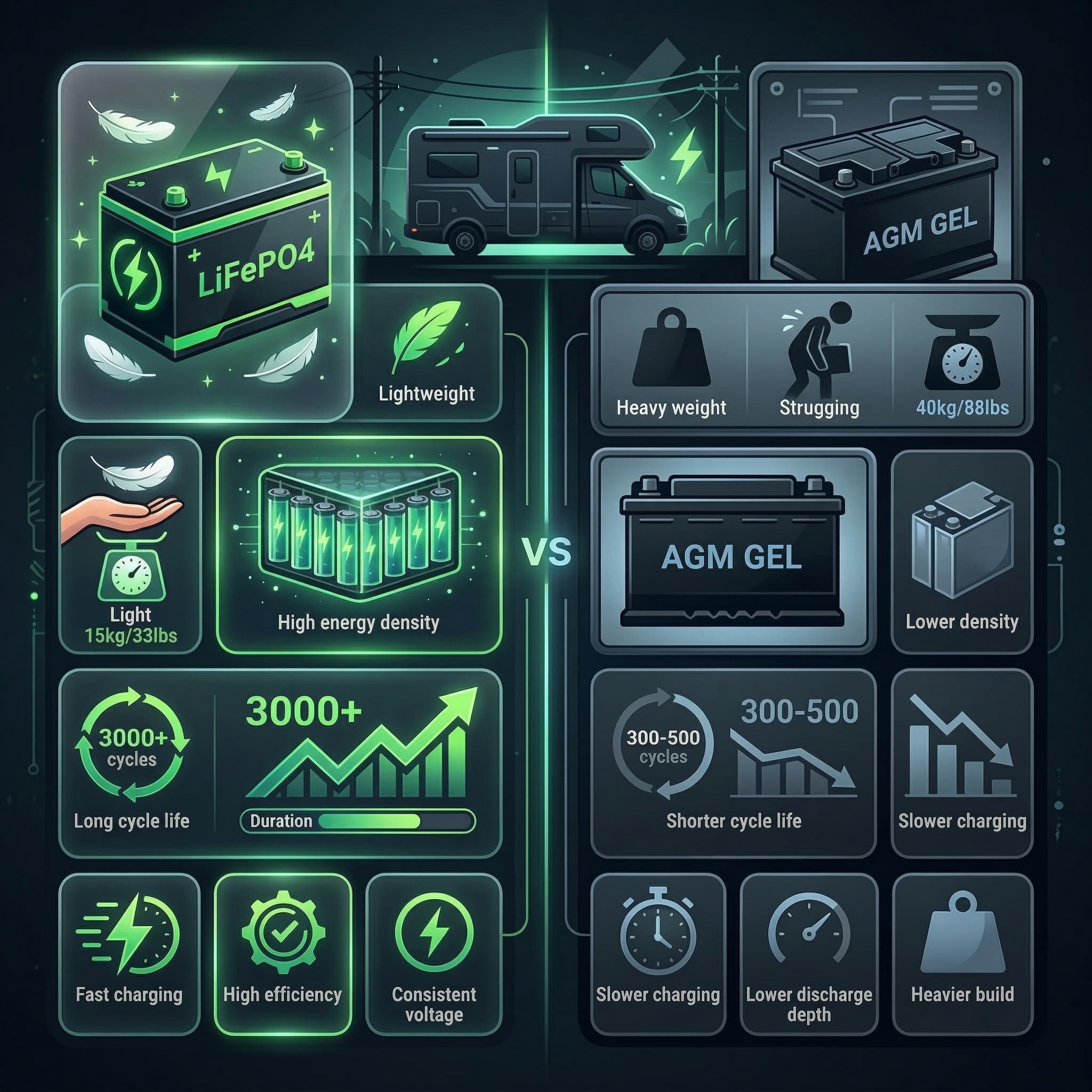
⚡ Expert tip
If you don't have shore power, use your alternator. Drive for 3+ hours with the DC-DC charger pushing the battery to 14.6V. The key is sustained time at absorption voltage, not how fast you get there. Set your DC-DC charger absorption time to maximum.
Example calculation for your setup
Results based on a typical use case
| Appliance | Power | Usage/day | Wh/day |
|---|---|---|---|
| Compression fridge | 45W | 24h | 1080 |
| LED lighting | 20W | 4h | 80 |
| Water pump | 30W | 0.5h | 15 |
| Phone charging | 15W | 2h | 30 |
| Daily consumption | 1205 Wh | ||
Recommended LiFePO4 battery
126 Ah
(80% depth of discharge)
Recommended AGM battery
201 Ah
(50% depth of discharge)
Adjust these values with the calculator below
VANPOWERCALC PROYOUR ENERGY PROFILE
YOUR ENERGY PROFILE.
This document contains the sizing of your future electrical installation, calculated based on your appliances.
Minimum Daily Consumption
0 WH / DAY
Inventory:
SYSTEM SIZINGPage 2
Battery
To guarantee 0WH without damaging your bank (80% max discharge):
0 AH
LiFePO4 12V
Solar
Minimum power required to recharge your consumption:
0 W
via MPPT
220V AC
Maximum power (with 25% safety margin).
0 W
No Need
Safety & CablingPage 3
12V Cable Sizing Guide
Use this professional reference table to select the correct gauge (mm²) for your cables. For 12V in a van, the maximum tolerated voltage drop is 3%. Always use multi-stranded flexible automotive wire.
| Current (A) | Round trip < 2m | Round trip 4m | Round trip 6m |
|---|---|---|---|
| 5A (LEDs, USB) | 1.5 mm² | 2.5 mm² | 4 mm² |
| 10A (Fridge, Pump) | 2.5 mm² | 4 mm² | 6 mm² |
| 20A (Heater) | 4 mm² | 10 mm² | 10 mm² |
| 50A (DC/DC Booster) | 10 mm² | 16 mm² | 25 mm² |
| 100A (Inverter) | 25 mm² | 35 mm² | 50 mm² |
Fuse Sizing
The fuse protects the wire, not the appliance. Always place it as close to the power source as possible (battery or busbar).
- Wire 1.5 mm² → Max fuse 10A
- Wire 2.5 mm² → Max fuse 20A
- Wire 4 mm² → Max fuse 30A
- Wire 6 mm² → Max fuse 40A
- Wire 10 mm² → Max fuse 60A
SCHÉMA ÉLECTRIQUE
PANNEAUX SOLAIRES
0W
REGULATEUR MPPT
BATTERIE AUXILIAIRE
0 Ah
Lithium LiFePO4
FUSIBLE
FUSIBLE
BOÎTE À FUSIBLES 12V
Pompe, Leds, Frigo...
CONVERTISSEUR 220V
NON REQUI
PRO GEARPage 4
SHOPPING LIST
Where to find this equipment? Here is the community-approved selection.
12V 6-way Fuse Box
Mandatory protection
Digital Multimeter
Test your connections
Heavy Duty Crimping Tool
For perfect lugs
Heat Shrink Tubing
Insulation and safety
GENERATED BY VANPOWERCALC PRO - UNLIMITED.
About this tool
I've helped a dozen people fix this exact issue with SOK 206Ah batteries. The problem isn't the battery -- it's how we charge it.
The SOK BMS uses passive balancing, which is the norm for batteries under $1,000. Passive balancers bleed charge from the highest cell through a resistor at about 30-60mA. Active balancing (which moves charge between cells) exists in premium batteries but costs 2-3x more.
The fix is simple but requires patience. Step 1: Connect a shore power charger (not solar) set to LiFePO4 profile with 14.6V absorption voltage. A Victron Blue Smart IP22 or similar works perfectly.
Step 2: Set the absorption time to at least 4 hours. Some chargers let you configure this directly. On a Victron, you can set it in the app. If your charger auto-switches to float too fast, keep manually restarting the charge cycle.
Step 3: Check individual cell voltages if you can. The SOK has a Bluetooth app that shows cell-level data. You want all 4 cells within 0.02V of each other. If one cell is 0.1V higher, it will take about 4-6 hours of balancing. If 0.2V higher, expect 8-12 hours.
Step 4: Repeat this top-balance every month if you mostly charge via solar. Solar rarely holds absorption long enough for passive balancing to work.
If cells are more than 0.3V apart after a 12-hour balance attempt, something else is wrong. One cell may have higher internal resistance -- that's a warranty issue. SOK support has been responsive in my experience, usually replacing the battery within 2-3 weeks.
Prevention: once a month, charge from shore power (or a DC power supply) and let the battery sit at 14.6V for 4+ hours. Think of it like an oil change -- boring but necessary.

Frequently asked questions
How do I know if my SOK cells are out of balance?▼
Use the SOK Bluetooth app to check individual cell voltages at full charge (14.6V total). All 4 cells should be 3.60-3.65V each and within 0.02V of each other. If one cell is 3.55V while others are 3.65V, they're out of balance.
Can cell imbalance damage the battery?▼
Not directly, but it reduces usable capacity. The BMS shuts down when ANY cell hits the low-voltage cutoff (2.5V). If one cell is 0.1V lower than the rest, you lose roughly 10-15% of usable capacity because that weak cell triggers shutdown early.
How long does top-balancing take?▼
Depends on the imbalance. At the SOK's 30-60mA passive balancing rate: 0.05V difference takes 2-3 hours, 0.1V takes 4-8 hours, 0.2V takes 8-16 hours. All at 14.6V absorption voltage. More than 0.3V? Call SOK support.
Is the SOK 206Ah still a good battery despite this?▼
Yes. Cell drift is normal in any LiFePO4 battery -- it's not a SOK-specific defect. The SOK 206Ah delivers genuine capacity, has Bluetooth monitoring, and costs around $400-500. For the price, it's hard to beat. Just commit to monthly top-balancing.
Will an active BMS battery solve this?▼
Active BMS batteries balance during both charge and discharge at 1-2A instead of 30-60mA. Much faster equalization. But they cost $800-1200 for 200Ah. If you charge mostly from solar and rarely reach 14.6V, an active BMS battery might be worth the premium.